
Packing Clothes, Shoes & Jewelry: Common Mistakes & When to Let Pros Handle It
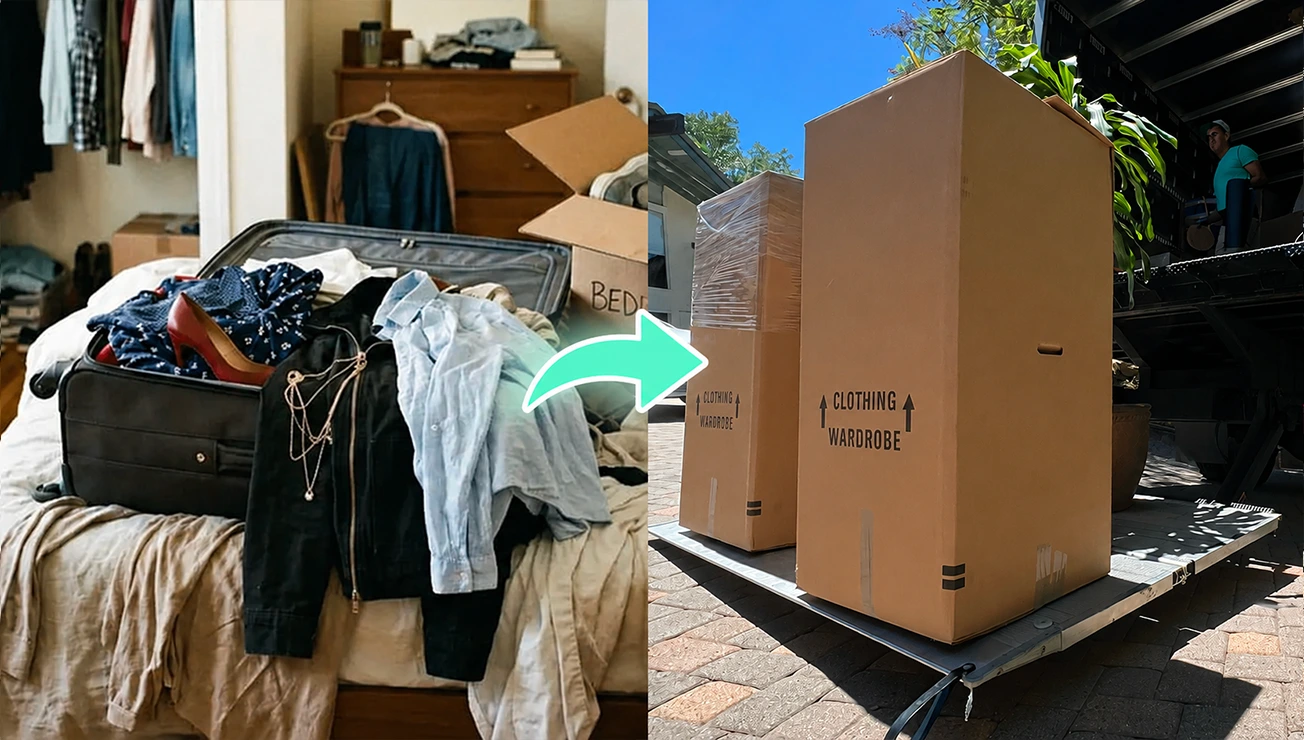
Clothes usually take up more space in a move than people plan for. The process looks deceptively simple until you’re three hours in, half the closet is still on hangers, and you’ve run out of boxes for the second time.
Most packing mistakes with clothes, shoes, and jewelry come from treating them as the “easy” category. The physical fragility is lower than that of glassware or electronics, but the time cost of doing it wrong is high. Wrinkled suits, crushed shoes, and tangled jewelry each feel minor on their own. They add up to a slow, frustrating unpacking experience that stretches out for weeks. We know exactly what actually goes wrong and how to approach each category correctly.
Packing Clothes for a Move: Common Mistakes to Avoid
Understanding how to pack clothes for moving correctly starts with the most common mistakes, nearly all of which come from prioritizing speed over method:
- Overfilling boxes is the most widespread error. A box packed too tightly becomes difficult to carry, risks structural failure during transit, and compresses fabric in ways that are hard to reverse for anything with structure or body. Medium fill levels with a flat, stable top layer are easier to stack and significantly safer for the clothes inside.
- Mixing without sorting creates an unpacking problem that lasts for days. Seasonal items mixed with daily-use clothing means hunting through every box for what you need on day one. Sorting by season or category before packing takes an extra hour and saves many hours on the other end.
- Using old or free boxes for clothes carries a specific risk. Used cardboard absorbs odors, retains moisture from previous use, and can harbor pests. For anything you intend to wear after the move, new boxes or sealed storage bags are worth the modest extra cost.
- Skipping wardrobe boxes for hanging items is where most closet damage happens. Standard boxes force folding, which causes creasing in anything that doesn’t fold naturally: blazers, structured dresses, tailored trousers. Wardrobe boxes prevent this entirely.
Knowing how to pack clothes when moving to a new home also means considering what happens to them in transit if the move takes more than a few days. Sealed containers and moisture protection matter more than most people expect.
How to pack clothes for storage follows the same logic: dry, clean materials, breathable containers, and no compression of delicate fabrics for extended periods. Vacuum bags work well for seasonal items, but shouldn’t be used long-term on structured clothing.
How to pack clothes for moving cross-country adds another layer of consideration. Temperature changes, humidity shifts across regions, and vibration over hundreds of miles accumulate in ways a local move doesn’t produce. For cross-country moves, sealed vacuum bags for seasonal items and properly labeled wardrobe boxes for hanging pieces are the practical baseline.
Hanging Clothes & Clothes on Hangers
The question of how to pack hanging clothes for moving is one of the most practical problems in any closet-heavy household. The answer most professional packers use is also the simplest: wardrobe boxes.
Wardrobe boxes are tall, structured boxes with a hanging bar built across the top. Clothes stay on their hangers, hanging vertically, exactly as they would in a closet. For suits, dresses, structured shirts, and anything with fabric that holds its shape, this method consistently delivers wrinkle-free results.
Knowing how to pack clothes on hangers for moving matters most for a few specific categories:
- Suits and blazers lose their shoulder structure quickly when folded under pressure.
- Formal dresses that are compressed in a box often need professional steaming upon arrival.
- Leather and structured garments can crease permanently if packed incorrectly.
For anyone with a large wardrobe, the time savings justify wardrobe boxes before considering the protection benefits. Removing every item from a full closet, folding it, boxing it, unboxing it, and re-hanging it is a full-day project. How to pack clothes on hangers for moving with wardrobe boxes turns that into a 20-minute transfer in and a 20-minute transfer out.
How to pack hanging clothes for moving also offers a protection advantage that standard boxes don’t. The closed, upright space keeps fabric away from dust, prevents contact damage between adjacent items, and limits exposure to any external moisture during transit.
How to pack clothes on hangers correctly means keeping groups to a manageable number per box, not overcrowding the hanging bar, and using the box floor for folded items like sweaters or jeans that don’t need to hang. Heavier garments like coats should be grouped rather than mixed with lighter pieces that can get crushed under their weight.
Packing Shoes: Why They Get Crushed (and How to Avoid It)
Shoes are awkward to pack well. They’re heavy, irregularly shaped, and most people don’t have a dedicated approach for them until they’ve already experienced a move where something expensive arrived deformed.
How to pack shoes for moving correctly means keeping pairs together, protecting them individually, and treating leather, suede, and structured styles as items that can be permanently damaged in transit.
The most common damage pattern is simple: shoes are placed into a box in whatever configuration fits, they shift freely during the drive, and by the time you unload, they’re scratched, crushed, or no longer hold their original shape. Premium sneakers, leather dress shoes, and tall boots are especially vulnerable. The cost of a good pair of shoes often exceeds the cost of an entire moving supply kit, making casual packing a poor financial decision.
A practical approach to how to pack shoes for moving: keep pairs in their original boxes where possible. When that’s not an option, wrap each pair individually in packing paper, stuff the toe area with tissue or crumpled paper to maintain shape, and pack them upright rather than on their sides. Heavy footwear, like boots, goes at the bottom of the box; lighter shoes go on top.
Shoes should always travel separately from clothing. Sole contact with fabric leaves marks and transfers dirt, and even clean soles press against fabric in ways that are difficult to wash out.
Sorting shoes by type or season before packing makes unpacking faster and keeps related items together. For long-distance moves, extra wrapping between pairs prevents surface contact throughout the extended transit time.
Packing Jewelry: Protecting Small, High-Value Items
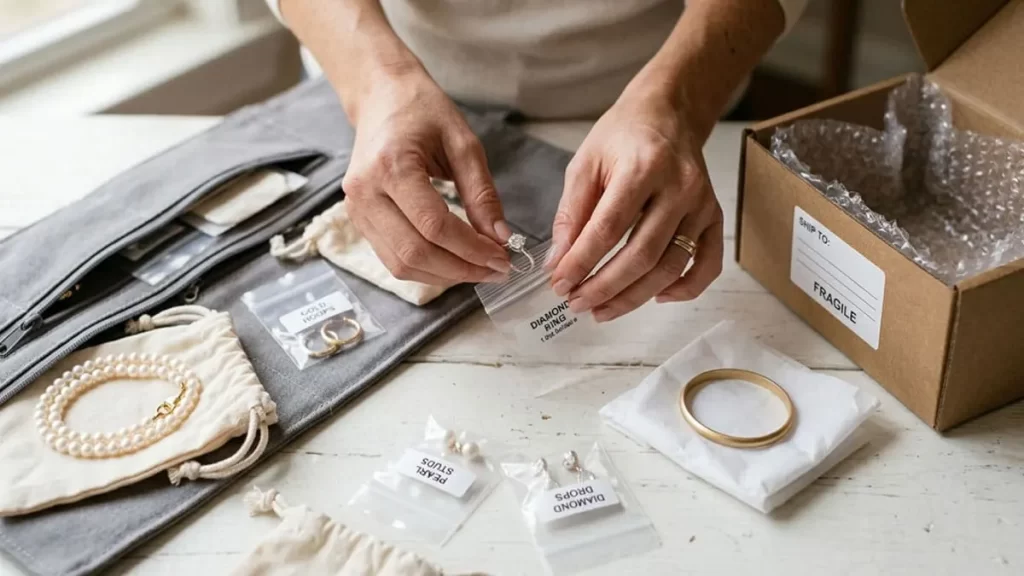
Jewelry is the category where small packing errors produce the highest consequences. Tangles, scratches, and losses from casually packed jewelry can take hours to fix or may be impossible to undo.
How to pack jewelry for moving properly means treating it as a completely separate category, not as a small add-on to a clothing box.
Chains tangle when they move freely. Each chain and bracelet should be individually wrapped or stored in a compartmentalized organizer that prevents contact between pieces. Earrings and small items benefit from a dedicated container with individual sections. The time spent on organization before packing pays for itself on arrival, when you’re not spending an afternoon untangling necklaces.
How to pack jewelry for moving when it involves high-value or irreplaceable pieces follows a different rule: don’t put them on the truck. Valuable jewelry, family heirlooms, and anything with significant sentimental or financial value should travel with you personally, in a carry bag or case under direct supervision throughout the move. A reputable moving company will give you exactly this advice. It’s standard practice for items that can’t be replaced.
For everyday jewelry, a small portable organizer or compartmentalized case works well. Clear pouches with zip closures keep categories visible and separated. Soft cloth wrapping around individual pieces prevents surface scratching during transport. Rings and earrings can share a small container with dividers; necklaces should each have their own section or wrapping to prevent tangling.
When to Let Professionals Pack
Self-packing is reasonable for a small local move with a simple wardrobe. The calculation changes in a few specific situations.
How to pack clothes when moving over significant distances changes the stakes considerably. How to pack clothes for moving long distances isn’t only a question of technique. It’s about the fact that vibration, temperature shifts, and extended transit time affect materials in ways a short local move doesn’t produce. For a long-distance move, the question is whether your available time and skill level match what a professional packing team delivers under liability.
A large wardrobe of business or designer clothing is the clearest case for professional help. Wardrobe boxes, quality materials, and systematic handling by experienced packers produce more consistent results than most people achieve on their own, in significantly less time. Next Moving’s packing service includes wardrobe boxes, handles all wrapping and boxing, and takes on liability for anything the team packs. That accountability matters when expensive or irreplaceable items are involved.
The time factor is real and often underestimated. A professional team packs a full household in a single session. Most individuals doing it themselves over a weekend are rushed, inconsistent, and tired by the third room. Packing the wardrobe and jewelry box at 11 pm the night before moving day is where the most avoidable damage happens. Fatigue replaces care, and shortcuts get taken on the items that need attention most.
Packing Clothes, Shoes & Jewelry FAQ
What’s the best way to pack clothes for moving?
Sort by category before packing. Hanging items go into wardrobe boxes. Folded clothes go in medium boxes at manageable fill levels. The core principle for how to pack clothes for moving is that everything should arrive organized enough to use immediately, without a full repacking project on day one.
How do you pack clothes on hangers?
Wardrobe boxes with a built-in hanging bar are the standard solution. Group items by type, keep the hanging bar at a reasonable capacity, and use the box floor for additional folded items. How to pack clothes on hangers for moving this way takes about the same time as packing into regular boxes, with far better results at the other end.
How should you pack jewelry so it doesn’t tangle?
Wrap each chain individually or use a compartmentalized jewelry organizer. Keep high-value pieces with you during the move rather than in the truck. How to pack jewelry for moving correctly comes down to individual separation and not treating jewelry as a low-priority task on a busy packing day.
Is professional packing worth it?
For large wardrobes, expensive clothing, or any move that covers a significant distance, professional packing reliably delivers better results than self-packing under time pressure. Knowing how to pack clothes for moving correctly is useful; having a trained team do it under liability protection is more reliable.
Common questions
When to Let Professionals Pack?
Self-packing is reasonable for a small local move with a simple wardrobe. The calculation changes in a few specific situations. How to pack clothes when moving over significant distances changes the stakes considerably. How to pack clothes for moving long distances isn’t only a question of technique. It’s about the fact that vibration, temperature shifts, and extended transit time affect materials in ways a short local move doesn’t produce.

