
Packing Art, Lamps & Framed Pictures: Why Valuables Deserve a Pro
Art, lamps, and framed pictures break more often than almost anything else in a self-packed move. Weight isn’t the problem, but the technique is. A thirty-dollar lampshade and a three-thousand-dollar painting usually get the same treatment: wrap, box, hope. Both end up cracked, torn, or scratched at the other end.
Most people treat fragile items like everything else in the house: stack them, tape them, move on. That mindset doesn’t survive contact with glass, canvas, or a porcelain lamp base. This guide covers how to pack art for moving the right way: real materials, real technique, and the mistakes that quietly destroy valuable pieces.
Why Art, Lamps, and Framed Items Deserve Special Care
Three things set these items apart: odd shapes, fragile surfaces, and high value relative to size.
A tall lamp doesn’t fit a standard box, and neither does a wide flat frame. Glass and acrylic scratch from a single stray contact: no drama required, just carelessness. Knowing how to properly pack art for moving matters because the materials involved (porcelain, gilding, stretched canvas) tend to be far less forgiving than drywall or wooden furniture.
Size lies about value too. A framed print might weigh five pounds and cost four hundred dollars to replace. An original oil painting, lighter still, can run anywhere from a few thousand dollars to the tens of thousands.
Some damage patterns surprise people:
- Glass fronts crack from the sustained pressure of stacked boxes, not from sudden impact
- Canvas dents permanently from one careless finger press
- Lampshade fabric absorbs ink stains from ordinary packing paper, permanently
- Gilded frames flake wherever tape touches the surface
Replacement glass for an oversized frame costs $80 to $200, but a damaged canvas is often irreparable; the piece is simply gone.
Boxes and Materials You’ll Need
Bad materials cause more damage than bad technique. Newsprint ink bleeds into fabric, and the porous frame finishes almost every time. Plastic wrap against canvas traps moisture, and the condensation warps the surface. Standard boxes flex under stacked weight, and flexing cardboard means cracked glass.
| Item | Box Type | Padding | Notes |
| Table lamps | Medium box | Bubble wrap, packing paper | Pack shade separately |
| Lamp shades | Specialty shade box | Acid-free tissue only | Never newsprint |
| Small framed pictures | Picture box or dish-pack | Bubble wrap, glass tape | Add corner protectors |
| Large framed art | Telescoping mirror box | Bubble wrap plus foam corners | Custom crate above $1,000 |
| Canvas art | Canvas-specific or mirror box | Glassine paper, foam board | No plastic wrap on canvas |
Telescoping picture and mirror boxes cost five to fifteen dollars at moving supply stores – cheap insurance, really. Gather all materials before starting, because anyone researching how to pack art for moving falls into the same trap: substituting whatever’s on hand when the right material runs out mid-pack.
How to Pack Lamps for Moving
Lamps seem simple until you’re holding a snapped porcelain neck at the other end of the move. The base is fragile, the shade dents under light pressure, the harp bends if bumped, and the cord tangles around everything nearby.
The most important rule for how to pack lamps for moving is to take the lamp apart completely before packing anything. The correct sequence:
- Unplug the lamp, unscrew the bulb, and wrap it separately in bubble wrap
- Remove the harp (the metal loop holding the shade) – it unscrews from the socket
- Take off the shade and box it separately
- Remove the finial, bag it, and tape it to the base for reassembly
- Wrap the cord around the base, secure with painter’s tape
- Wrap the base in bubble wrap, two layers minimum, with extra padding at the neck
Shades follow different rules entirely, and this is where how to pack lamps trips people up most consistently. Skip any printed or newsprint paper, since ink transfers onto fabric and paper shades permanently. Acid-free tissue or unprinted packing paper works correctly. Pack the shade upside down with two inches of padding on all sides, and never nest one shade inside another – the inner shade deforms the outer one’s shape under any real pressure.
Floor lamps with multi-piece poles need disassembly at every joint, with hardware bagged and taped to its matching section. The damage that keeps showing up: lamps, packed and assembled, break at the socket where the base meets the body. Most modern lamp sockets can’t be field-repaired, so that break usually means total loss, which is exactly why the how to pack lamps for moving shortcut of leaving it whole never pays off.
How to Pack Pictures and Framed Art for Moving
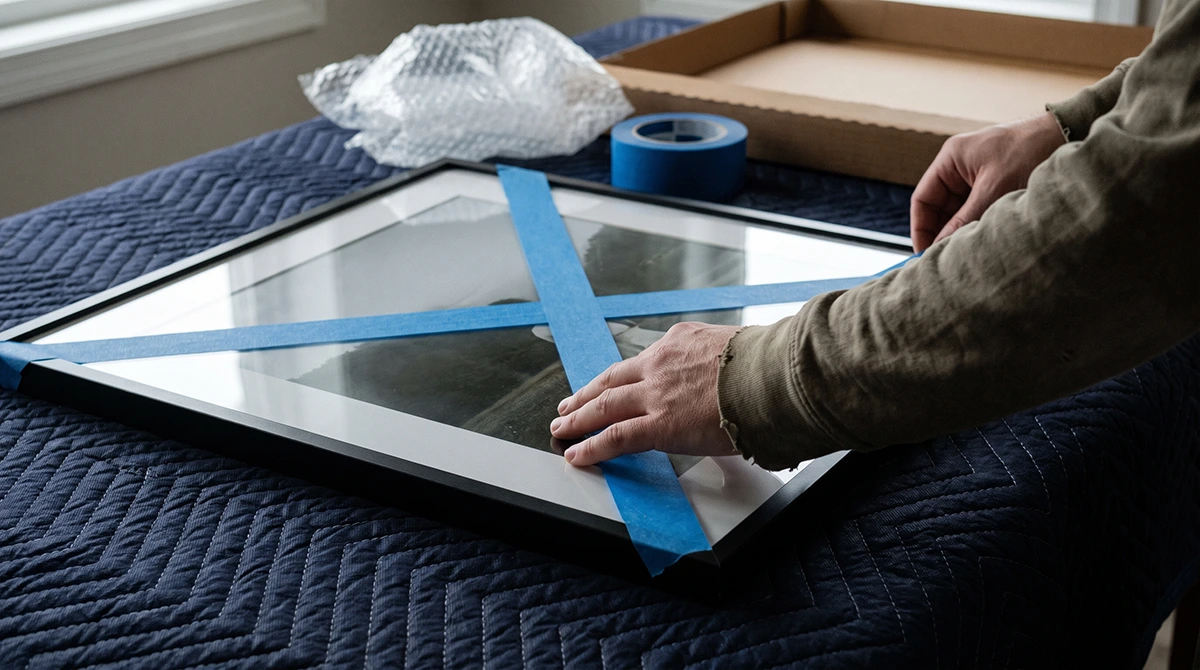
Start by dusting the frame and cleaning the glass before any wrapping begins; anything trapped underneath becomes a scratch in transit. Apply painter’s tape in an X across the glass front. It won’t stop breakage, but it holds shards together if the glass shatters during the move.
Wrap the frame in glassine or unprinted paper first, never in newsprint. Add foam corner protectors to the four impact-prone edges, then apply two layers of bubble wrap, with the heavier layer facing the glass. Secure everything with stretch wrap rather than tape directly on the frame. This routine covers how to pack framed pictures for moving and how to pack pictures for moving in the same motion – the order rarely needs to change regardless of size.
Use a telescoping box with one to two inches of padding around the entire piece. Fill any gaps with crumpled paper rather than loose packing peanuts, which shift during transport and concentrate pressure directly on the glass. Load boxes vertically in the truck, never flat – flat stacking cracks glass from cumulative pressure over hours, not from a single impact, and that rule holds for every version of how to pack pictures for moving.
Wall art often comes with wire hangers or D-rings that can scratch neighboring frames if left in place. This detail matters most for how to pack wall art for moving, since gallery pieces hang and pack closest together in transit. Remove hangers or pad them separately, and label each piece by its wall position so unpacking at the other end stays organized.
The single biggest mistake in how to pack framed art for moving is stacking heavy boxes on top of picture boxes. Glass doesn’t fail immediately – it cracks from sustained pressure over the course of the drive, long after loading is finished and nobody’s watching. For larger pieces, foam board across the back of the frame adds structural rigidity that padding alone can’t provide. How to pack framed art for moving correctly at that scale means treating structural support as seriously as surface protection.
How to Pack Canvas Art and Canvas Pictures
Canvas has its own rulebook: the painted surface itself takes the damage and dents permanently under direct pressure; there’s no glass layer absorbing the impact for you.
How to pack canvas art for moving starts with glassine paper laid over the painted surface. Never use plastic wrap, newsprint, or standard packing paper. Wrap the piece in bubble wrap with the bubbles facing outward – inward-facing bubbles press a texture pattern directly into the canvas surface under any real weight. Foam board on both faces adds the rigidity the canvas needs for transport, and the boards are taped together without actually touching the painted surface.
Unframed, stretched canvases need equal care on both sides. Pressure against the back deforms the stretcher tension just as easily as pressure from the front. This applies whether it’s a large gallery canvas or something closer to how to pack canvas pictures for moving – the smaller pieces people assume are sturdier than they actually are. Never stack canvases face-to-face, and never lean them, unpadded, against a wall or the truck side while loading. How to pack canvas art for moving correctly means treating every canvas as a surface that can be permanently marked by a single moment of carelessness, which is exactly true.
Packing Large Pictures and Oversized Art
Anything past thirty-six inches on its longest side needs a different approach, because this is where how to pack large pictures for moving stops being a bigger version of the standard frame routine and becomes a structural problem.
Three options actually work at this scale: telescoping picture boxes, a custom cardboard sleeve built from two sized pieces, or a wood crate for high-value pieces. Structural support matters most here. Even careful padding won’t stop a six-foot frame from flexing during transport, and that flex cracks corner joints reliably. Foam board across the entire back provides the rigidity that padding alone cannot. Ratchet straps keep oversized pieces from shifting in the truck. Load them vertically, ideally with the last on and the first off.
For anything over four feet tall, professional crating usually costs less than an insurance deductible. That math is the real answer behind how to pack large pictures for moving once the size crosses that threshold.
When Professional Packing Is Worth It
DIY packing has genuine limits, and a few situations make professional help the clearer choice. Original art over $1,000, where crating and proper insurance are already built into a reputable packing service. Large pieces over four feet, where materials alone begin approaching professional pricing. Antique or sentimental items with no realistic replacement value. Long-distance moves, where extended vibration and climate shifts add real cumulative risk.
Materials for a typical household’s worth of art and lamps run from $150 to $300, often close to half of what professional packing costs for the same items. That’s the point where how to pack art for moving stops being a technique question and becomes a straightforward cost comparison.
Next Moving offers full-service packing for fragile and valuable items across the Greater LA area. The team uses glassine, foam corners, telescoping boxes, and proper stretch wrap as standard equipment, and anything they pack is covered by liability insurance. For art, lamps, and framed pieces specifically, that liability matters in a way it simply doesn’t for towels and books.
Packing Art and Lamps FAQ
Can I use a newspaper to wrap framed pictures?
No. Ink transfers onto frame finishes and fabric surfaces and rarely comes off fully. Use glassine or unprinted packing paper instead.
How do I pack a tall floor lamp for moving?
Disassemble it at every joint (base, pole sections, harp, shade, and finial) and wrap each part separately. Bag the small hardware and tape it to its matching section so nothing gets lost in transit.
What is glassine paper and where do I buy it?
It’s a smooth, moisture-resistant paper that won’t stick to paint or varnish. Moving supply stores, art supply shops, and most packaging retailers carry it.
How should framed pictures be loaded in a moving truck?
Vertically, never flat, and never underneath heavier boxes. Flat stacking applies steady pressure that can crack glass hours after loading, long after anyone’s stopped paying attention.
Should I insure my art separately for a move?
For anything valuable, yes. Standard mover’s liability rarely reflects a piece’s actual worth, and separate fine art coverage closes that gap effectively.
Common questions
Why Art, Lamps, and Framed Items Deserve Special Care?
Three things set these items apart: odd shapes, fragile surfaces, and high value relative to size. A tall lamp doesn’t fit a standard box, and neither does a wide flat frame. Glass and acrylic scratch from a single stray contact: no drama required, just carelessness. Knowing how to properly pack art for moving matters because the materials involved (porcelain, gilding, stretched canvas) tend to be far less forgiving than drywall or wooden furniture. Size lies about value too.
How to Pack Lamps for Moving?
Lamps seem simple until you’re holding a snapped porcelain neck at the other end of the move. The base is fragile, the shade dents under light pressure, the harp bends if bumped, and the cord tangles around everything nearby. The most important rule for how to pack lamps for moving is to take the lamp apart completely before packing anything.
How to Pack Pictures and Framed Art for Moving?
Start by dusting the frame and cleaning the glass before any wrapping begins; anything trapped underneath becomes a scratch in transit. Apply painter’s tape in an X across the glass front. It won’t stop breakage, but it holds shards together if the glass shatters during the move. Wrap the frame in glassine or unprinted paper first, never in newsprint. Add foam corner protectors to the four impact-prone edges, then apply two layers of bubble wrap, with the heavier layer facing the glass.
How to Pack Canvas Art and Canvas Pictures?
Canvas has its own rulebook: the painted surface itself takes the damage and dents permanently under direct pressure; there’s no glass layer absorbing the impact for you. How to pack canvas art for moving starts with glassine paper laid over the painted surface. Never use plastic wrap, newsprint, or standard packing paper. Wrap the piece in bubble wrap with the bubbles facing outward - inward-facing bubbles press a texture pattern directly into the canvas surface under any real weight.

