
Hiring Movers: 10 Questions to Ask Before You Sign

Most people don’t think about hiring movers until they’re standing in an apartment full of boxes, deadline looming, panicking a little. Not the best time to start comparing companies, honestly. Packing up your whole life and getting it across town, or across the country, takes more than a truck and someone with a strong back. It takes the right company. And the right company isn’t always the one that quoted you the least.
A lot of people just go with whoever’s cheapest. That’s usually the mistake that turns a moving day into a disaster story you’re still telling five years later. Price matters, but whether your stuff shows up on time, in one piece, without some surprise charge tacked on at the end? That’s mostly about how reliable the carrier actually is.
Why These Questions Matter
Before you even pick up the phone, it’s worth understanding why any of this matters in the first place. You’re not hiring some random labor for an afternoon. You’re handing someone the keys to your entire household – furniture, documents, the stuff you genuinely can’t replace if it breaks. Hiring movers should come down to transparency and an actual track record, not just whoever sounds friendliest on the phone. A few extra minutes of vetting can save real money and a lot of unnecessary stress.
- Movers get access to your personal belongings, so the company needs to be operating officially, with a reputation that holds up, not just a suspiciously perfect five-star page.
- Nailing down terms ahead of time is how you avoid hidden fees showing up out of nowhere on move day.
- Experienced crews use the right equipment and actually know how to pack and load without wrecking your stuff. You can’t tell that from a website photo.
Cost of Hiring Movers: What You Should Expect to Pay
Knowing the cost of hiring movers ahead of time means you’re planning a budget, not getting blindsided halfway through. Figure out what’s included, what the contract actually covers, and where the extra charges tend to sneak in. That’s really it. Good value isn’t the lowest number – it’s trustworthiness, experience, and insurance coverage backing up that number.
Here’s a rough breakdown:
| Move type | Local (1-2BR) | Local (3-4BR) | Long-distance |
| Hourly (most common local) | $400 – 900 | $900 – 1,800 | n/a |
| Flat rate local | $500 – 1,200 | $1,200 – 2,500 | n/a |
| Long-distance (weight-based) | n/a | n/a | $2,000 – 7,000+ |
| Cross-country | n/a | n/a | $4,000 – 10,000+ |
These are ballpark numbers for hiring movers cost – actual pricing moves around based on crew size and how complicated the job is, not just miles on a map. If a quote looks way too low, that’s not a lucky break. Treat it as a warning sign.
- Local (1-2 bedrooms). Hourly rates land around $400 to $900 for most local jobs. Some companies will quote a flat rate after seeing the place in person; usually close to double the hourly range, but it locks the number in, and a lot of people would rather pay more for that certainty than watch a clock.
- Local (3-4 bedrooms). More rooms, more stuff, more hands needed. Expect $900 to $1,800 hourly, or $1,200 to $2,500 flat, depending on how complicated things get.
- Long-distance. For longer hauls, hiring movers costs usually come down to weight. Most jobs fall somewhere between $2,000 and $7,000, though distance and add-on services push that around a lot.
- Cross-country. A real cross-country move can run $4,000 to $10,000 or more. More logistics, more crew, and, honestly, plan this one month out, not weeks.
How to Choose a Moving Company
Sooner or later, everyone hits the same wall: how to choose a moving company that won’t leave them regretting it. It’s not a small decision – it touches the safety of your belongings, what you end up paying, and whether moving day is smooth or a headache. Here’s roughly how to work through it.
- Planning. For long-distance, start three months out if you can swing it. Local moves need less runway: four to six weeks is usually enough to compare quotes and lock in a date.
- Estimates. Before figuring out how to hire a mover, get things in writing from at least three companies. A number someone said over the phone means nothing once move day actually arrives.
- Licenses. Confirm that the company is properly licensed and has the right carrier authority. A legit outfit hands over its license number without you having to ask twice.
- Feedback. Non-negotiable, this one. Check Google, Yelp, the BBB, and actually read the last 12 months’ negative reviews included. Those tell you more than the five-star ones ever will.
- Recommendations. People keep asking how to choose a moving company they can actually trust, and honestly? A five-minute call with someone who used the company recently beats a wall of anonymous comments online.
10 Questions to Ask Movers Before You Sign
This is really the heart of what to know before hiring movers. These questions to ask movers aren’t just an optional checklist; they’re what separates a company that respects your time and your stuff from one that doesn’t. A legitimate mover answers all ten without flinching:
- Are you fully licensed and insured for moves in this state? A real company says yes immediately and offers up documentation or a license number without hesitating. Still worth double-checking that registration yourself through the state authority; don’t just take their word for it.
- Are your movers full-time employees or day laborers? Full-time crews train together and work together regularly. Day laborers who grab last-minute often don’t have the experience to handle things carefully, and it shows.
- Do you provide a binding written estimate before the move? Binding means the price stays the same, unless you add services yourself. Companies that only offer loose, non-binding numbers? Brace for a final bill that’s a lot bigger than expected.
- What is your pricing structure and what’s included? One of the more important questions to ask movers is whether it is hourly, flat-rate, or weight-based, and what exactly that number covers.
- What is not included in the base price? Ask about stairs, long carries from truck to door, packing, disassembling furniture, or specialty items like pianos and safes. This is where the hidden costs like to hide.
- Do you offer full-value protection or basic liability only? Basic liability can be as low as $0.60 per pound, nowhere near enough to replace a busted TV. Ask specifically about full-value protection instead, which covers repair or replacement at the actual value.
- What’s your claims process if something is damaged? A trustworthy mover has a defined process, a real response window, and an actual person you can talk to. Thirty days for a response is a fair standard to expect.
- Can I see recent reviews on Google, Yelp, and BBB? Any decent company will point you to their profiles without hesitation. Look at the past year and watch for the same complaint popping up more than once – that’s a pattern, not bad luck.
- What’s your cancellation policy? Most reputable movers let you cancel or push your date free of charge up to 48-72 hours out. A small deposit kept for very last-minute cancellations is normal.
- Do you require a deposit, and if so, how much? Typically 10-25% of the total. If someone’s asking for half or all of it upfront, that’s not how this industry works, and it’s a reason to walk away.
At Next Moving, this is basically the same list our own clients run through before booking, and honestly, we’d rather people ask than assume. We’re upfront about our license number, offer free virtual estimates so there’s no guessing beforehand, and packing and wrapping come standard, not something you find out costs extra halfway through the day.
Is Hiring Movers Worth It? Moving Yourself vs Hiring Movers
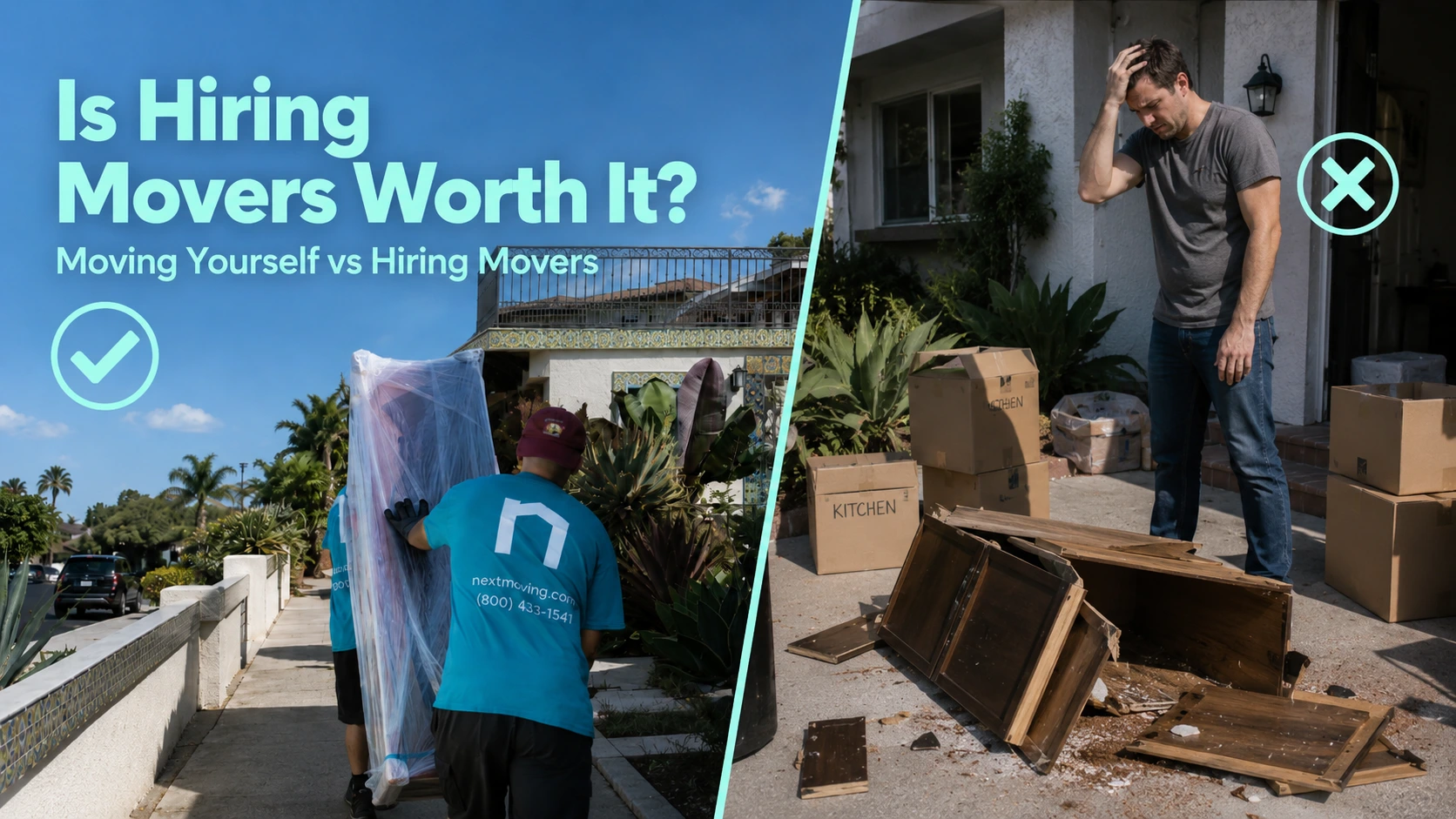
Just about everyone ends up weighing moving themselves vs hiring movers at some point. It comes down to what your own time and physical effort are worth, and how much risk of injury you’re okay taking on. Common mistake: overestimating your own stamina. Carrying a couch down two flights of stairs sounds a lot easier before you’re three hours into actually doing it.
Here’s the real comparison:
- DIY. For a typical two-bedroom, doing it yourself usually means a rented truck, gas, packing supplies, and probably a few friends bribed with pizza. Looks cheap on paper; if you don’t count your own body, or the awkward debt of favors owed. Makes the most sense for small places without much stuff.
- Hiring movers. When you actually weigh moving yourself vs hiring movers, the trade-off is pretty simple: professionals bring the experience and the equipment, and you have to supervise. A professional local move can run roughly double what DIY costs, but it saves the exhaustion and usually finishes faster. For fully furnished homes, staircases, anything fragile or genuinely valuable – professionals are almost always the safer bet.
So, is hiring movers worth it? For anything past a studio apartment with a handful of boxes, yes, usually. The time saved and the stress avoided tend to outweigh the extra cost.
Red Flags That Should Make You Walk Away
Price alone should never decide for you. Plenty of bad experiences start with warning signs that are easy to miss if you’re not paying attention. Part of understanding is hiring movers; it is also knowing when a specific company isn’t. Watch for:
- A company that won’t give an accurate quote without seeing your place first, in person or on video – legit movers want to know what they’re actually moving.
- Cash-only movers demanding a deposit way above the usual 25%.
- Just a PO box, no real office address anywhere.
- Nobody picks up during normal business hours.
- Suspiciously flawless five-star reviews with zero complaints, even great companies get the occasional bad review. That’s normal.
- The same complaint keeps showing up: damaged property and hidden fees. That’s a pattern.
- Trucks with no branding at all, which often means subcontracted or casual labor instead of an actual crew.
- A quote that’s noticeably lower than everyone else’s. That’s rarely a deal. It’s usually a setup for hidden fees later.
Hiring Movers FAQ
How much does it cost to hire movers for a 2-bedroom apartment?
Locally, $700 to $1,500 is typical. If a quote comes in well under that, ask directly about hidden fees before booking.
How far in advance should I book a moving company?
4-6 weeks for local moves; 8-12 weeks for long-distance moves. Booking early just means more time to actually vet people instead of settling for whoever still has a slot.
Should I tip my movers, and how much?
Not required, but appreciated; 10-20% of the total is a reasonable range if the crew did you right.
Is moving insurance worth it for a local move?
Pretty much yes, especially with expensive furniture or electronics involved. Basic liability alone usually isn’t enough to cover what you’d actually lose.
Can movers refuse to deliver if I don’t pay extra fees?
Not if those fees weren’t in the original contract. Which is exactly why a written, binding estimate matters so much; it’s what stops you from getting pressured into paying more than you agreed to.
Common questions
Is Hiring Movers Worth It? Moving Yourself vs Hiring Movers?
Just about everyone ends up weighing moving themselves vs hiring movers at some point. It comes down to what your own time and physical effort are worth, and how much risk of injury you’re okay taking on. Common mistake: overestimating your own stamina. Carrying a couch down two flights of stairs sounds a lot easier before you’re three hours into actually doing it. Here’s the real comparison: DIY.

